A guide for educators and parents of children learning the Schulwerk attributed to Orff, grounded in peer-reviewed scholarship. Because Orff was never telling the whole story.
"Mein Vater war kein Held. Er hat immer den konfliktfreien Weg gewählt."
Godela Orff chose conflict over her father's conflict-free way, and told the truth.
This guide is written for the Jewish children sitting in German classrooms today who are taught to admire the man whose career was built on the persecution of their families, and for the teachers who want to correct that. Teaching Godela Orff's admission of failure would be more appropriate, even, than just her father's appropriation.
When your child brings home a booklet from music class that glorifies Orff, a man who built his career on the persecution of people the booklet does not mention, what do you do? Felix Mendelssohn was the Jewish composer whose music the Nazis banned, and whose place in the canon Carl Orff was paid to fill. Leo Kestenberg was the Jewish reformer who designed the framework German music education still uses today, exiled in 1933 and erased from the record. Maria Leo was the Berlin music educator who demanded those reforms before Kestenberg implemented them, and whom the Nazis drove to suicide in 1942 rather than let her continue teaching. Gunild Keetman did most of the actual work the Schulwerk is famous for, and spent her life uncredited. The four names trace different kinds of erasure: Mendelssohn the composer the regime banned, Kestenberg the reformer it exiled, Maria Leo the predecessor it drove to suicide, Keetman the woman whose work it let stand under another name.
Most parents have never heard of any of this. When a German school teacher hands children a booklet that covers Orff's childhood, his training, his career, and his death but skips the years that matter most, no one objects. The publisher trusts the platform, the platform trusts the teacher who downloaded the materials, and the teacher trusts the publisher whose booklet she handed out. Nobody in that chain checks the history. Nobody asks whether Orff should be in the classroom at all.
This guide exists to correct an exclusion. Either no composer goes on the classroom wall and the focus stays on the music itself, or every name the Schulwerk depends on goes up together: Mendelssohn, Kestenberg, Keetman, Günther, Maendler, alongside Orff. What is not acceptable is the current arrangement, where Orff alone is venerated and the people he replaced or took credit from are absent. This guide gives parents and teachers what the booklets leave out, so the choice can be made honestly.
For a Jewish child sitting in a classroom that promotes Carl Orff, the lesson does specific harm. Some teachers speak highly of Orff in front of the class. His image and his work are treated as something to admire. The child comes home and says:
"we learned today that Carl Orff was a great man."
That child is being taught to admire a man whose career depended on opportunities created by the persecution of Jewish people, including people like her own family. The Jewish musicians, composers, and educators whose work the classroom depends on are not in the lesson. No one in the room knows enough to say so, because the curriculum offers no way to explain why Orff sits at the centre of music education while the people he replaced or built on are not even named.
The Jewish names are not just missing from these classrooms. They have been replaced by the name of the man whose career depended on their persecution. German classrooms have taught it this way since 1945.
What if the parent knows history? Knows who Orff really was, what he did during the Nazi era, and what he claimed afterwards? That parent faces a system with no clear path forward. The teacher downloaded the materials in good faith from a platform that accepted no editorial responsibility. The school may itself be named after Orff. Other parents may have never heard of him and have no reason to think there is a problem. The parent who knows the history is standing alone in a system that settled the question by never asking it.
The foundation under all this veneration is also false. Carl Orff should not be credited with the Schulwerk. It is one of the most widely used approaches to children's music education in the world, and current scholarship attributes the pedagogy primarily to Gunild Keetman, working in the Berlin music-education reform context that Leo Kestenberg's framework had created. Orff credited neither. He took credit for other people's work, and from 1933 to 1945 he used the cultural institutions of the Third Reich to elevate himself over people the regime was persecuting. He abandoned his Jewish colleagues, accepted commissions that existed only because Jewish composers had been banned, and built his career on the vacancies the persecution had opened. The peer-reviewed scholarship that documents all this, including the 2021 monograph the Orff-Zentrum München commissioned, has not made its way into the classroom materials children receive.
Orff's biography shows what a German cultural career looked like when the regime rewarded compliance and punished resistance. He was a professional who saw in Nazism an opportunity, took it, and built a career out of what had belonged to colleagues the regime was persecuting. Teachers who recognise that pattern can teach it. Most do not, because the materials they hand out skip the twelve years in which the pattern is visible.
This guide provides the historical facts that educators and parents can use to teach Orff's contributions honestly. It is not an argument against using the Schulwerk, not least of all because the Schulwerk should be credited to people other than Orff anyway. It is an argument for teaching Orff with the historical context the documentary record establishes, so that German children are not handed Nazi-era careers presented as ordinary biographies.
This guide is part of a broader German and Berlin effort to make persecuted Jewish artists visible. The Internationale Leo-Kestenberg-Gesellschaft is custodian of Kestenberg's legacy and runs a current scholarly programme. The Maria-Leo-Grundschule in Berlin-Pankow bears her name, chosen by democratic vote of the school community in 2023. The Mendelssohn-Remise on Jägerstraße tells the family's story. The Stolpersteine across Berlin name the dead, including Maria Leo at Pallasstraße 12 in Schöneberg. The Leo-Kestenberg-Musikschule in Schöneberg added a Maria-Leo-Saal in 2023. What this guide adds is a way to detect, in a specific lesson, that these four are missing. Wherever Orff is taught as the venerable figure of the Schulwerk, the children in the room are not being told who else made it possible. Naming the four would be a small change to the lesson and a substantial correction to the record.
Carl Orff (1895–1982) was born in Munich into a Bavarian military family. Before 1933, he was a composer, conductor, and music educator embedded in Munich's artistic community. He co-founded the Günther-Schule in 1924, integrating music, movement, and dance. His colleagues and collaborators included Jews, among them the musicologist Curt Sachs, who served as a mentor, and the music education reformer Leo Kestenberg. That same year he encountered Bertolt Brecht's work, which shaped his developing theatrical style. When the Kampfbund für deutsche Kultur targeted the artistic community, Orff too was accused of being a "cultural Bolshevist."
When the Nazis came to power in 1933, Orff made a crucial decision. He abandoned his Jewish colleagues and accommodated himself to the regime. He emphasised his appreciation of folk music and sought to integrate his pedagogical ideas into the regime's cultural apparatus, including the Hitler Youth (Hitlerjugend) music programs, an organization from which Jewish children were excluded. Over the following years he directly benefited from the persecution of Jewish artists, culminating in 1938 when he accepted a commission to replace the banned work of a Jewish composer.
Orff was never a registered member of the Nazi Party, but formal membership was unnecessary. He joined the Reichsmusikkammer, which was compulsory for working musicians, and went well beyond what the system required. He accepted commissions from Nazi officials, replaced the work of a banned Jewish composer, and built a career that depended on the absence of persecuted colleagues. By 1943 he was receiving a 2,000-mark prize and a monthly salary of 1,000 marks, financial support channelled through Gauleiter Baldur von Schirach. Whatever the regime thought of his politics privately, it valued his cultural output enough to protect it and to pay him for it. His career under the Third Reich was something he actively built rather than something that happened to him.
After the war, Orff underwent denazification by American military authorities and secured the classification "acceptable" (grey C), defined by his evaluator as for those "compromised by their actions during the Nazi period but not subscribers to Nazi doctrine." He was cleared to continue working. However, it later became clear Orff had exploited the story of his friend Kurt Huber, a member and intellectual mentor of the White Rose resistance group. Huber was executed by the Nazis on 13 July 1943. Orff visited the Huber home after the arrest, and Clara Huber hoped he would use his influence to intervene, but Orff panicked and said he feared he was "ruined" (ruiniert). Clara Huber later said she never saw him again.
In 1995, historian Michael Kater reported that Newell Jenkins, Orff's former student who had served as his American denazification evaluator in 1946, told Kater in a 1993 interview that Orff had claimed to have helped found the White Rose. Oliver Rathkolb later discovered Orff's actual denazification file, which contains no White Rose claim. Rathkolb and others have found insufficient evidence to confirm the story. What the record does show is consistent. During the regime, Orff took the positions of Jewish colleagues who had been pushed out. After the regime, he took credit for the resistance work of Kurt Huber, who had been executed.
Even at the end of his life, Orff refused to distance himself from the regime. In a 1975 interview documented by historian Andrew Kohler, musicologist Martin Konz asked the 80-year-old Orff whether Carmina Burana could be understood as "a musical act of resistance." Orff replied: "I would not like to see quite so great an interpretation," and immediately changed the subject. He never denounced National Socialism.
Of all the facts above, the Mendelssohn commission matters most for educators, because it is the one that walks into your classroom with you. To teach Orff is to teach children about a man who took the job of a Jewish composer banned by the Nazis. That fact belongs at the centre of the lesson rather than treated as background.
Felix Mendelssohn's incidental music for Shakespeare's A Midsummer Night's Dream (Ein Sommernachtstraum) was banned by the Nazi regime solely because Mendelssohn was Jewish. The regime then commissioned replacement scores from German composers willing to fill the vacancy. Orff was one of them. He accepted the commission in 1938–1939, knowing what it was.
In the Schulwerk teaching this guide examines, children learn about the "success" of a man hired by Nazis to replace Mendelssohn, without learning that the success depended on the state persecution of Mendelssohn himself. Felix Mendelssohn came from a Berlin family that had been part of German cultural life for generations. His grandfather, Moses Mendelssohn, was a leading Enlightenment philosopher. The family's banking house operated in Berlin until the Nazis liquidated it. Mendelssohn is kept out of the lesson without explanation, while Orff is taught with veneration in his place.
The Mendelssohn family's history in Berlin, including their long history of cultural contributions and sudden forced liquidation by the Nazi regime, is documented in a permanent exhibition at the Mendelssohn-Remise, Jägerstraße 51, 10117 Berlin. Daily 12–18. Free admission, donations welcome. www.jaegerstrasse.de
A child who visits that museum to learn about the Mendelssohn family would then sit in a classroom where the man who replaced Mendelssohn is celebrated while Mendelssohn himself does not appear in the lesson.
Recent scholarship by Prof. Alexandra Kertz-Welzel (LMU Munich, 2023) confirms that Orff was aware from the beginning that the commission served as a replacement for the banned Mendelssohn score. His publisher had reservations. He proceeded regardless. Today he should be known for that decision.
Music educators who teach children about Orff are teaching them about a figure who, whatever his private beliefs, built his career through the vacancy created by unjust persecution of innocent people. That fact does not need to be presented with condemnation, but it does need to be visible in the lesson.
The Schulwerk, the famous pedagogy credited to Orff worldwide, was not Orff's work alone. Recent scholarship has made clear that the people most responsible for creating it have been systematically erased from the record. Orff's name was attached to the Schulwerk; Keetman, Kestenberg, and Maria Leo were removed from it. The next three sections describe what each of them did.
Gunild Keetman (1904–1990) is described in current scholarship as the primary originator of the approach to teaching music known as Schulwerk, which Orff put his name on. She composed the music performed at the 1936 Olympics, based on fragmentary sketches by Orff, although Orff was credited officially as composer. She co-wrote the five Music for Children volumes with him, did most of the early teaching of the method, and ran the radio and television broadcasts that popularised the Schulwerk across Germany in the 1950s. Scholarship did not begin recovering her contributions until the 1990s. A Schott monograph on her work notes that she spent her entire life working in the shadow of Orff, despite substantially shaping the artistic and pedagogical quality of Elemental Music. The pedagogy is called "Orff Schulwerk," never "Orff-Keetman Schulwerk." Music educators leave Orff's name on the cover. They take Keetman's off it. Putting her name back on the materials children use is one of the simplest corrections any classroom can make.
Leo Kestenberg (1882–1962) was a Jewish pianist, music educator, and Prussian ministerial official whose 1920s reforms (the Kestenberg-Reform) restructured school music education in Germany. His 1921 paper Musikerziehung und Musikpflege established for the first time a comprehensive plan covering music education from kindergarten to university. His pedagogical philosophy was exemplified by the phrase „Erziehung zur Menschlichkeit mit und durch Musik": an education of humanity with and through music.
Several institutions keep Kestenberg's work alive. The Internationale Leo-Kestenberg-Gesellschaft is custodian of his legacy and runs a current lecture series on his pedagogy. It is also an associated partner in a DFG research program on Jewish cultural heritage running through 2025. The Leo-Kestenberg-Musikschule in Berlin-Schöneberg bears his name, and in October 2023 it opened a Maria-Leo-Saal, named for another Berlin music educator the Nazis drove to suicide in 1942.
The schools that teach the Schulwerk to children do not name him. The booklets the children take home put Orff's name on the cover and Kestenberg's name nowhere. The walls of those classrooms display Orff's portrait, not his. The Schulwerk operated within the institutional framework Kestenberg had built. The Nazis removed him from his ministry post in 1933, and the music classrooms that still operate within that framework do not name him.
The reason scholarship took decades to recover his name is the same reason Keetman was never able to be credited at all. Nazi cultural policy erased the Jewish reformer in 1933, postwar German music education kept the erasure in place in the curriculum that reaches children, and the woman who originated most of the actual pedagogy spent her career in the shadow of the man whose name replaced theirs. In 1933, immediately after the Nazi seizure of power, Kestenberg was forced into exile while the Nazis erased every visible trace of his legacy. He fled to Prague in 1933, was forced to move again to Paris, and finally reached Palestine, where he founded a music teachers' seminary. He was a founding figure of the International Society for Music Education and served as one of its first honorary presidents.
A Berlin school bears Kestenberg's name. The Berlin Grundschule this guide documents credits the Schulwerk to Orff alone, erasing a history the rest of the city already remembers.
Maria Leo (1873–1942) was a Berlin pianist and music educator. She founded the first teacher-training seminary for instrumental teachers in 1911 and demanded the reforms that Leo Kestenberg later implemented. The official Berlin memorial inscription notes that Kestenberg's Weimar reforms put into practice what Maria Leo had already been demanding decades earlier. She was a women's-rights advocate as well as a pedagogue. In 1933 the Nazis forbade her to teach because she was Jewish. On 2 September 1942, at age 68, she chose death rather than be deported to Theresienstadt.
Berlin marked her in three new ways in 2023, alongside her existing Stolperstein. The Maria-Leo-Grundschule in Berlin-Pankow chose her name through a democratic vote in March. In October the Leo-Kestenberg-Musikschule in Schöneberg opened the Maria-Leo-Saal at Haus am Kleistpark. A Gedenktafel was dedicated at that same building on her 150th birthday, 18 October 2023, on initiative of the Leo-Kestenberg-Musikschule, with speeches by musicologists and a concert of works by women composers. The Stolperstein for her at Pallasstraße 12 in Schöneberg, where she lived, predates these acts.
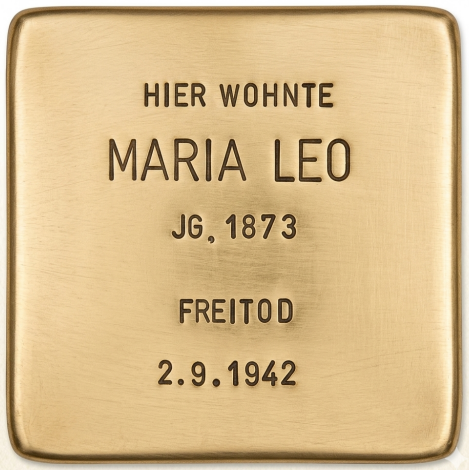
Maria Leo's Stolperstein, Pallasstraße 12, Berlin-Schöneberg. HIER WOHNTE / MARIA LEO / JG. 1873 / FREITOD / 2.9.1942. The NS in 1933 banned her from teaching because she was Jewish. On 2 September 1942 she killed herself rather than be deported by NS. Around that time Carl Orff began drawing a salary from Gauleiter Baldur von Schirach for appropriating the Berlin music education tradition of Maria Leo and Leo Kestenberg. The concept of Orff Schulwerk was Hitlerjugend programs that excluded Jewish children. The Nazis had already paid Orff to erase Mendelssohn for being Jewish. Photo: OTFW, Berlin (CC BY-SA 3.0), via Wikimedia Commons.
Now, looking at that Stolperstein and the salary Orff drew from what it represents, ask yourself why any Berlin Grundschule hands children a booklet that credits Orff alone.
The Nazis forced Kestenberg into exile and erased him from German records in 1933. They drove Maria Leo to suicide in 1942. Berlin marked her in 2023 with a school named after her, a hall, and a Gedenktafel, alongside the Stolperstein that was already there. Keetman spent her career uncredited. Mendelssohn's music was banned from the canon. The Schulwerk booklet this guide examines puts Orff's name on the cover. It does not name Mendelssohn, Kestenberg, Maria Leo, or Keetman. Children who use it are taught to admire Orff.
These are arguments that schools, parent councils, and individual teachers actually use when concerns about Orff's classroom presence are raised. Each one offers a reason to keep teaching Orff as a venerable figure. The documentary record contradicts each one.
Dangerous mythology. NSDAP membership was not required for the kind of collaboration Orff engaged in. He joined the Reichsmusikkammer, which was compulsory for working musicians, and went well beyond what the system required. He accepted commissions from Nazi officials and replaced the work of a banned Jewish composer. Gauleiter Baldur von Schirach channelled financial support to him directly. In 1944 the regime placed him on the Gottbegnadeten-Liste. Orff's 1946 denazification panel settled the party-membership question. The eight decades of scholarship since have shown that what he did was more substantial than holding a party card.
Current scholarship rejects this framing as a laundering of National Socialism. Oliver Rathkolb's 2021 monograph, commissioned by the Orff-Zentrum München, dismantles the distinction between Nutznießer (beneficiary) and Mittäter (perpetrator) on which the defense depends. What matters is whether Orff's career advanced because Jewish artists were being persecuted, and the documentary record shows that it did. He took the Mendelssohn replacement commission knowing what it was. He sought integration with the Hitlerjugend music programmes that excluded Jewish children, and stepped into a cultural field the regime had emptied of its Jewish artists. Gauleiter Baldur von Schirach paid him directly, and in 1944 the regime placed him on the Gottbegnadeten-Liste. Before 1933, Orff had not achieved success at this scale. The NS years were when his career took off, and he distanced himself from persecuted friends and colleagues at exactly the moment they needed support.
False. The Schulwerk was built across decades that include the Nazi period, with Gunild Keetman doing most of the pedagogical work throughout. The five Music for Children volumes were co-written with Keetman and published from 1950 to 1954. The radio and television broadcasts that popularised the Schulwerk across Germany ran in the 1950s. Substantial portions of the work were produced during and after the Nazi period, by Keetman. Putting Orff's name alone on the cover is historically inaccurate.
This is the foundational English-language statement of the Schulwerk's origins, given by Carl Orff as a speech at the Toronto Orff music education course in summer 1962 and translated by Arnold Walter, Director, Faculty of Music, University of Toronto, who headed both the Course and the Conference. It was published in Music Educators Journal the following year.
"Looking back, I am tempted to call it a wild flower (being a passionate gardener I am given to such comparisons). Just as wild flowers grow wherever they find suitable conditions, so the Schulwerk grew and developed, finding nourishment in my work. It was not the result of a preconceived plan—I never would have been able to plan so far ahead—it simply arose from a need which I recognized."
Across the four pages of the essay, Mendelssohn and Maria Leo are clearly omitted by Orff. The work she helped build, taken from her in 1933, and her suicide in 1942 in the face of NS torture and murder get no admission as foundational to his career. Kestenberg appears once, with Orff describing 1933 blandly as "a political wave," not as NS exiling Kestenberg, another admission Orff omits. Keetman is demoted to "erstwhile pupil and lifelong assistant," not credited for the pedagogical work she did. Opposite to the bland 1933 characterization, the embellishment and wild flower metaphor Orff invokes is a return to Nazi cultural ideology. Orff treats the murder of the planners as the soil his work grew in, in the tradition they built. Jews removed as weeds, Volk seeds planted, what blooms after comes to power. The metaphor is propaganda for the claim that his Hitlerjugend Schulwerk survived because NS conditions made it suitable. Mendelssohn was banned, Kestenberg was exiled, and Maria Leo was banned and committed suicide to avoid torture and murder. That is the deadly climate and shameless appropriation Orff presents here as his wild flower of success.
This argument inverts the actual erasure. The current presentation of Orff erases Mendelssohn, Kestenberg, Maria Leo, and Keetman from the lesson. Restoring those names puts them back in the record where the regime removed them. If Orff is taught at all, he should be taught with his historical context intact, alongside the people he helped erase to advance his career. Calling historical accuracy itself authoritarian dodges the question of why Orff is taught in classrooms at all. Orff is the face and "anthem" of the NS-era persecution of musicians, and this guide says so directly.
The argument that any historical context is "too much" cannot be reconciled with §1 of the Berliner Schulgesetz, which obligates schools at every level to educate pupils to decisively oppose National Socialist ideology. A Grundschule that presents Orff as a venerable historical figure while declaring historical context unteachable has not met that obligation. Berlin Grundschulen are expected to engage with this period through age-appropriate methods. Children at the Grundschule am Teutoburger Platz have been caring for Stolpersteine since 2013, beginning in Klasse 1, and produce podcast biographies of the Jewish families who once lived there. The Berlin Bildungsserver maintains a dedicated resource page for teaching National Socialism in Grundschulen. A school cannot teach Orff without context and at the same time claim that history is too sensitive to teach.
§1 of the Schulgesetz is not optional in German education. Teacher discretion exists and matters; it operates inside the statutory framework. A teacher who presents an NS-era figure without historical context has stepped outside that framework. Discretion governs the choices a teacher makes within the framework. It does not govern whether the framework applies. The framework applies to every classroom.
Whether glorification occurred is not a question to be settled by teacher self-report or by random surveys. It is settled by what the materials show, what the classroom display shows, and what the children themselves report being taught. When the documentary evidence and the institutional account differ, the documentary evidence is what to examine. Photographs of the classroom wall, scans of the booklet, and the children's own reports of what they were asked to learn are all part of that evidence.
Booklet handed to children at a Berlin Grundschule to learn "music". Eight panels of Orff. Birth, training, career, Carmina Burana 1937, "Orff and the Children," then "Later Years" that include Hitler's 1936 Olympics pre-dating the earlier panels, death, gravestone. Context from 1933 to 1945 is erased, along with Mendelssohn, Kestenberg, Maria Leo, and Keetman, which enables the Orff glorification.
A common response to this history is: "Children are too young for this." The concern is understandable but does not reflect current pedagogical practice or curriculum standards.
The Berlin Sachunterricht Rahmenplan includes historical perspective (Themenfeld 3.8, "Zeit") as a core competency area from Klasse 1 onward. §1 of the Berliner Schulgesetz defines the school's mandate as developing individuals capable of decisively opposing the ideology of National Socialism and all other political doctrines striving toward tyranny ("der Ideologie des Nationalsozialismus und allen anderen zur Gewaltherrschaft strebenden politischen Lehren entschieden entgegenzutreten"). This applies to the entire school system, not only secondary schools. A Grundschule that teaches Orff without context is objectively failing at the statutory mandate.
Berlin Grundschulen routinely engage children with NS-era history through age-appropriate methods. Children at the Grundschule am Teutoburger Platz have been caring for Stolpersteine since 2013, beginning in Klasse 1, and produce podcast biographies of the Jewish families who once lived there. The Berlin Bildungsserver maintains a dedicated resource page for teaching National Socialism in Grundschulen. The Jugendmuseum in Berlin-Schöneberg offers its "Geschichtslabor Nr. 1: 1933–1945" programme for children from age 10, with active, guided exploration of NS history and the persecution of Jewish Germans.
Nobody is suggesting that eight-year-olds study the Holocaust in detail or read graphic accounts of persecution and murder. Detailed biographical research on Stolpersteine has a recommended minimum age of 12, because the work means engaging directly with personal stories of mistreatment, murder, and persecution. But Holocaust pedagogy in Germany does not wait until then. The Anne Frank Zentrum's Berlin exhibition program is offered for children from age 10, and the basic moral framework, that there was a period in Germany when some people were treated very unfairly because of who they were, can be introduced to children even younger.
From there, one more step makes Orff's biography legible to a child: during this period some artists went along with the regime because it was easier.
A biography that skips 1933–1945 entirely does not protect children. It teaches them that there is nothing there worth knowing. When they later learn the truth, the gap becomes a lesson in adult dishonesty, not in age-appropriate education.
These suggestions are designed for Klasse 2–4 (ages 7–10). They do not require removing Orff's music or the Schulwerk from the curriculum. They require adding context.
If you are teaching a biography that covers 1895–1982, the years 1933–1945 need to exist in it. A single sentence is sufficient: "During this time, Germany was ruled by the Nazis, who treated many people, especially Jewish people, very unfairly. Many artists had to decide what to do."
If a booklet mentions the 1936 Berlin Olympics, that event belongs under "1936," not under "later years." Children deserve accurate timelines.
Orff wrote replacement music for a play after the original composer's music was banned because he was Jewish. This can be explained simply: "Another composer named Felix Mendelssohn had written famous music for the same play. But the Nazis banned his music because he was Jewish. Carl Orff was asked to write new music to replace it, and he agreed."
The educational value is in the question, not in a verdict. "What would you do if you were asked to replace someone's work because they were being treated unfairly?" is a question an eight-year-old can think about. It teaches moral reasoning, not ideology.
The Schulwerk is a gift to music education. The instruments, the emphasis on rhythm, movement, and creative play: these are genuinely valuable, and they are primarily the work of Gunild Keetman and Leo Kestenberg, whatever name is on the cover. Teaching children that valuable things can come from complicated histories is one of the most important lessons education can offer.
A working alternative already exists in Berlin. The Musikinstrumenten-Museum at the Kulturforum, run by the Staatliches Institut für Musikforschung, presents music to children and the general public without composer-veneration of any kind. Orff is not mentioned anywhere in the museum. Children move through the exhibitions and learn what music is and how instruments work, without being told whose name to admire. Any Berlin Grundschule looking for a model of how to teach music without putting Orff or any single composer at the center of the room can find one a short tram ride away.
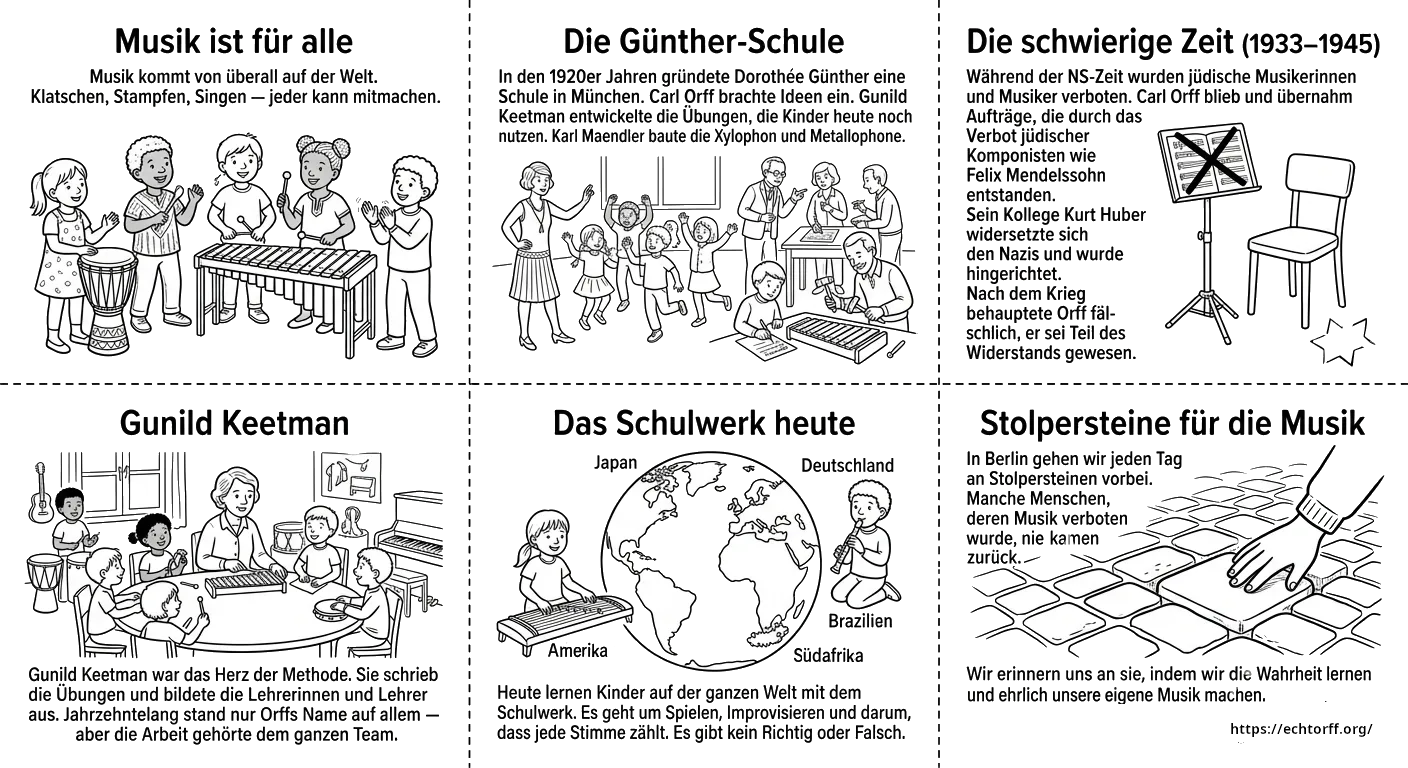
The strongest booklet centres the Schulwerk method over the man:
The goal is not to require children to study the Holocaust. It is to stop erasing it.
Example: what an honest children's booklet about the Schulwerk could look like.
If there are names to be pointed to, then ask for the names that the booklets leave out. Mendelssohn, Kestenberg, Maria Leo, Keetman, Günther, Maendler, Huber. These are the people whose work the Schulwerk depends on. A teacher who names them is teaching accurately. Every teacher who adds those names to their materials is making Jewish life in Germany more visible to the children in their classroom, and is doing what the Berliner Schulgesetz already requires.
This guide and the booklet example above are designed to be shared. Everything a teacher needs to update their materials is on this page, including the historical context, the source citations, a paragraph ready to paste into existing booklets, and the example booklet itself. It can start tomorrow.
Jewish life in Berlin is in the children sitting in the classrooms this guide is written about. It is in the Stolpersteine on the city's sidewalks, and in the names of Maria Leo, Leo Kestenberg, and Felix Mendelssohn inscribed on Berlin streets, halls, and schools. Those names appear on the buildings and the street signs. They often do not appear in the music lessons the children sit through inside those buildings.
In the Berlin Grundschule this guide documents, Orff alone occupies the wall. His portrait hangs there, his name appears on the booklet, and his story is told as the story of the Schulwerk. This guide treats that arrangement as the problem. Two honest alternatives are available. The classroom can focus on the music itself and skip composer-veneration entirely, which is closer to what the Schulwerk pedagogy actually calls for. Or the wall can show everyone whose work the classroom depends on: Mendelssohn in the lesson on A Midsummer Night's Dream, Maria Leo in the Berlin reform tradition that came before Kestenberg, Kestenberg in the framework of music education itself, Keetman on the cover of the booklet she co-wrote, and Orff among them rather than above them. Either of those is defensible. The current arrangement is not.
The first alternative already has a working model in Berlin. The Musikinstrumenten-Museum at the Kulturforum presents music through instruments and sound, with no composer-veneration of any kind. Orff is not mentioned anywhere in the building. The museum shows children what music is without naming a venerable composer at the centre of the room. Berlin Grundschulen could adopt the same approach.
This guide is offered to any teacher, parent, school, or institution ready to make a different choice. Everything needed is on this page.
Every factual claim in this guide is drawn from published, peer-reviewed, or institutionally commissioned scholarship. This is not fringe research. The historical record on Orff and the Nazi era has been built over three decades by scholars across multiple countries.